


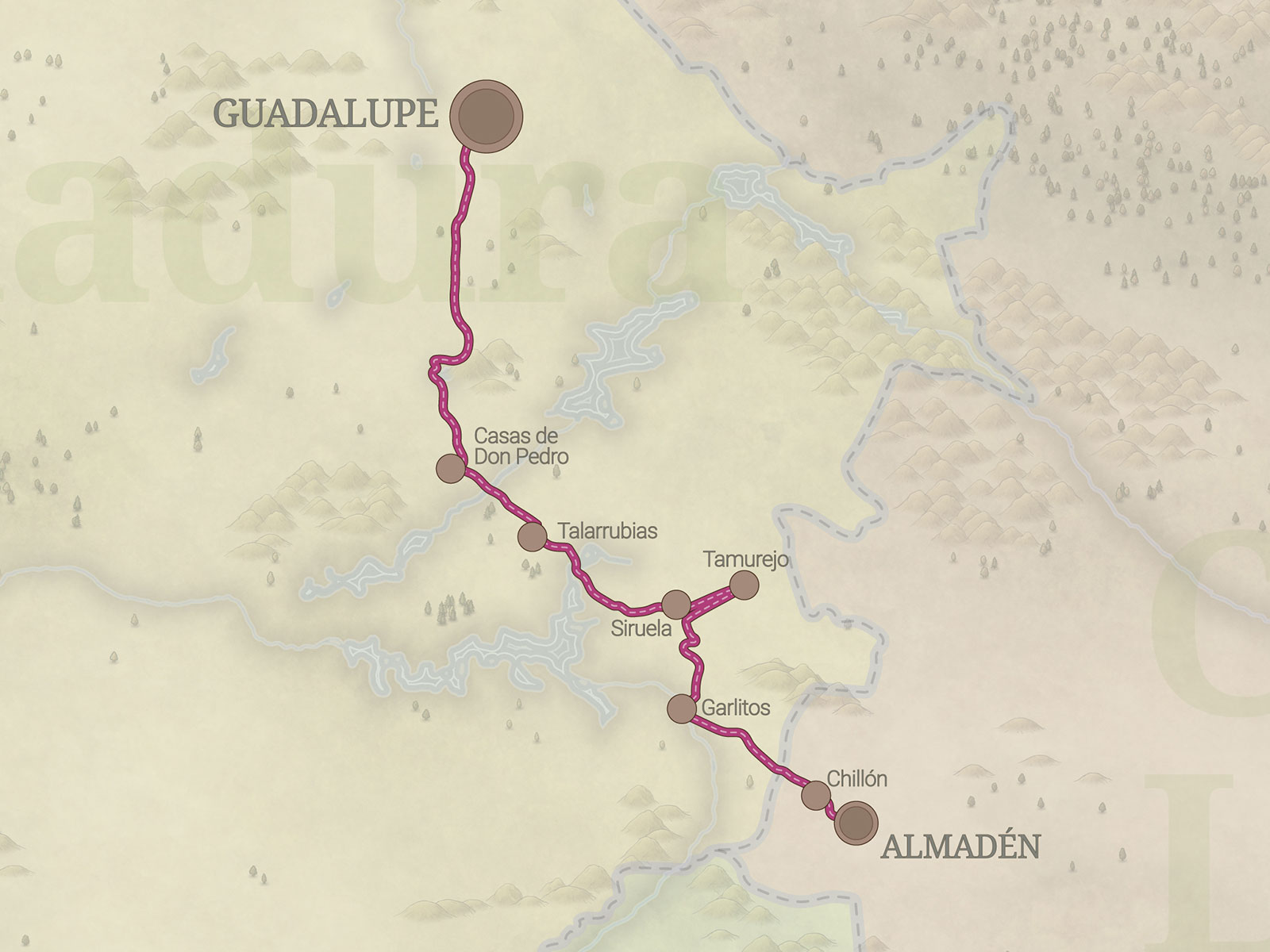
The history of this way runs parallel to the mining of mercury at Almadén, in the province of Ciudad Real, the starting point of our pilgrimage route. Although the mines were already worked by the Romans (ancient Sisapo), it was not until the discovery of America and its great silver mines that mercury consumption received its great boost, owing to the need to cold-amalgamate the extracted silver. From then on, the uses of mercury began to multiply. In the 16th century Paracelsus introduced its use in the treatment of syphilis, Torricelli used it in his barometer in 1643, and Fahrenheit in his thermometer in 1720. In fact, its use to relieve syphilis was the real link between Almadén and our monastery, since from the 16th century the Guadalupe apothecary used this mineral to treat this infectious disease. The so-called spring anointings, a mercury-based treatment for syphilis that the apothecary monks brought from the Almadén mines, became famous. The healthcare provided at this monastery enjoyed remarkable prestige throughout the country.
The historiography of Spanish medicine describes the importance of the Guadalupe hospitals as a genuine school of medicine at a time as early as the Late Middle Ages.
The proximity of Almadén to Extremadura, within what was formerly called the ‘Mancha Baxa Extremeña’, which stretched from Almadén itself to Siruela, in the province of Badajoz, and the existence of a map in the Monastery of Guadalupe remind us of the importance of this area for the transhumance of livestock between the north and south of the peninsula and for the supply of mercury for the running of the Guadalupe hospitals.
From Guadalupe to Almadén, travellers used a branch of the old Cañada Real Segoviana drove road of the Mesta, which ran from Talavera de la Reina down to Guadalupe and then continued through the Mancha Baxa towards the territories of Almadén, ending in Andalusia. One of the founders of the Order of Saint Jerome, Pedro Fernández Pecha, a leading collaborator of Alfonso XI closely involved in the consolidation of the new Hieronymite monasteries, especially San Bartolomé de Lupiana and Guadalupe, was the real driving force behind the quicksilver trade in Guadalupe, as around 1348 he leased the mercury wells of Almadén. Although the Spanish Crown later took charge of the productive Almadén mines, especially after the discovery of America, it did not neglect to establish close ties with the order for the supply of this mineral.


 Language: Spanish
