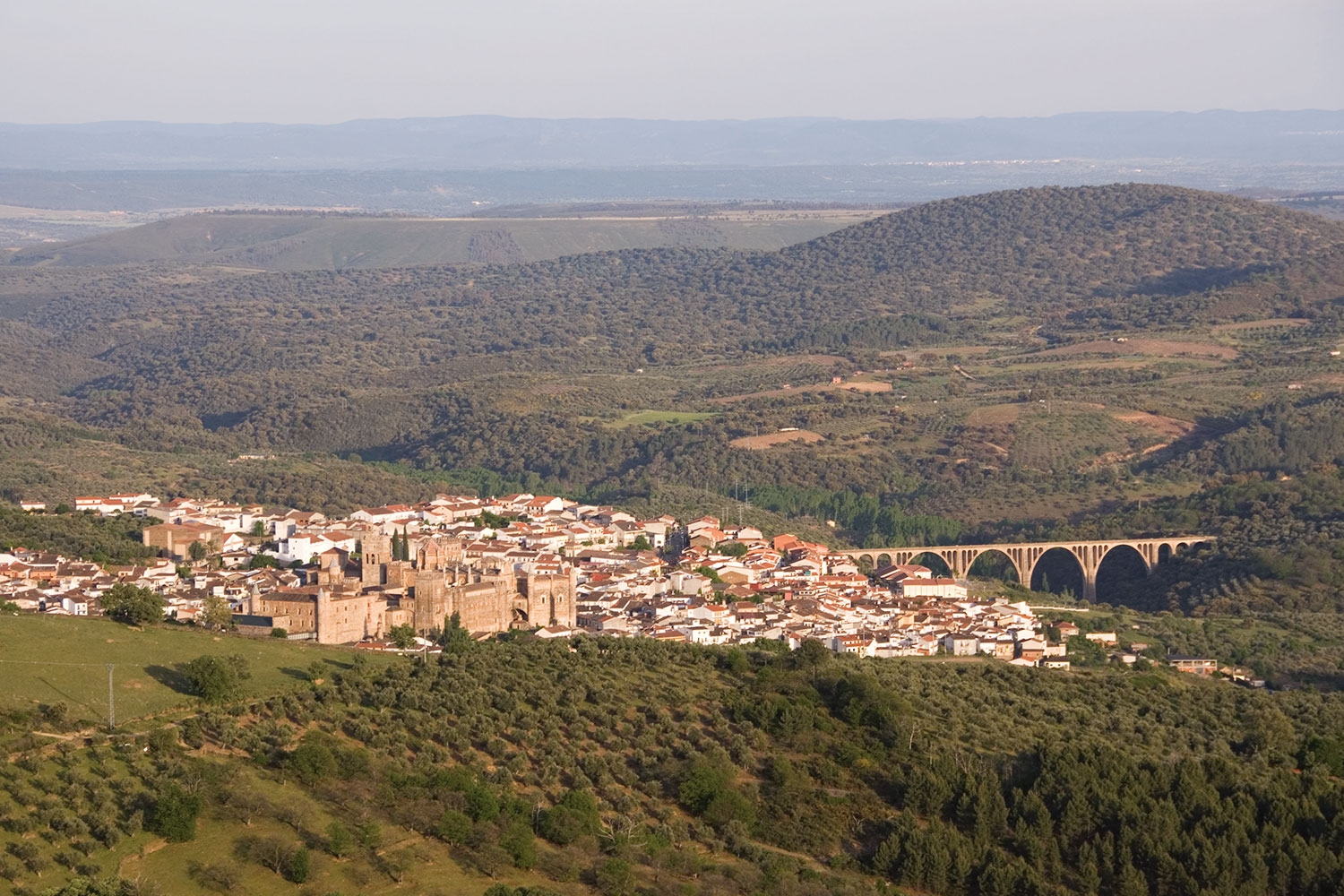


La Jara is a new Way to Guadalupe, a recently created pilgrimage route that forms an ecological and cultural corridor linking this district of Toledo with La Puebla de Guadalupe. It is not that the people of Calera y Chozas, Aldeanueva de Barbarroya or Campillo de la Jara did not visit the Morenita (the dark Virgin) back in the 16th and 17th centuries —they certainly did— but they would surely not have used this route, as it follows a railway line that was planned in the 20th century to link the lands of Talavera de la Reina with the Vegas del Guadiana.
The central section of this line, between Guadalupe and Santa Quiteria station, never had its trackbed consolidated, which has prevented its recovery as a Greenway; not so the other two sections, La Jara and Vegas del Guadiana-Villuercas, which now form part of the hundreds of kilometres recovered under this model across Spain. As it was impossible to unify the whole route under the Greenway label, the Ministry of the Environment and Rural and Marine Affairs chose to link them by building a Natural Path, the Camino Natural de Villuercas, a scheme very similar to Greenways in terms of structures and quality, although obviously not based on a railway trackbed but rather on the recovery of public paths.
So from the Minas de Santa Quiteria station, our new pilgrimage way continues to Guadalupe along the Camino Natural de Villuercas, a route steeped in history and of great environmental appeal, which not only invites us to relive Spain’s railway past —where, paradoxically, a train was never seen— but also lets us discover a historical and cultural heritage that is being rescued from oblivion, while we enjoy a unique view of natural areas designated as Special Protection Areas for Birds (SPA) and Sites of Community Importance (SCI).
We have therefore adopted this route as one more in the Ways to Guadalupe network, since, combined with the open trackbed of the Camino Natural de Villuercas, it allows these 110 kilometres of pilgrimage to be completed entirely by bicycle; and, although it is not an adapted trail, it can even be used by people with reduced mobility. Although they do not represent the traditional pilgrimage routes to Guadalupe, they connect with the new times, introducing other models that are, in essence, just as valid as the earlier ones.