

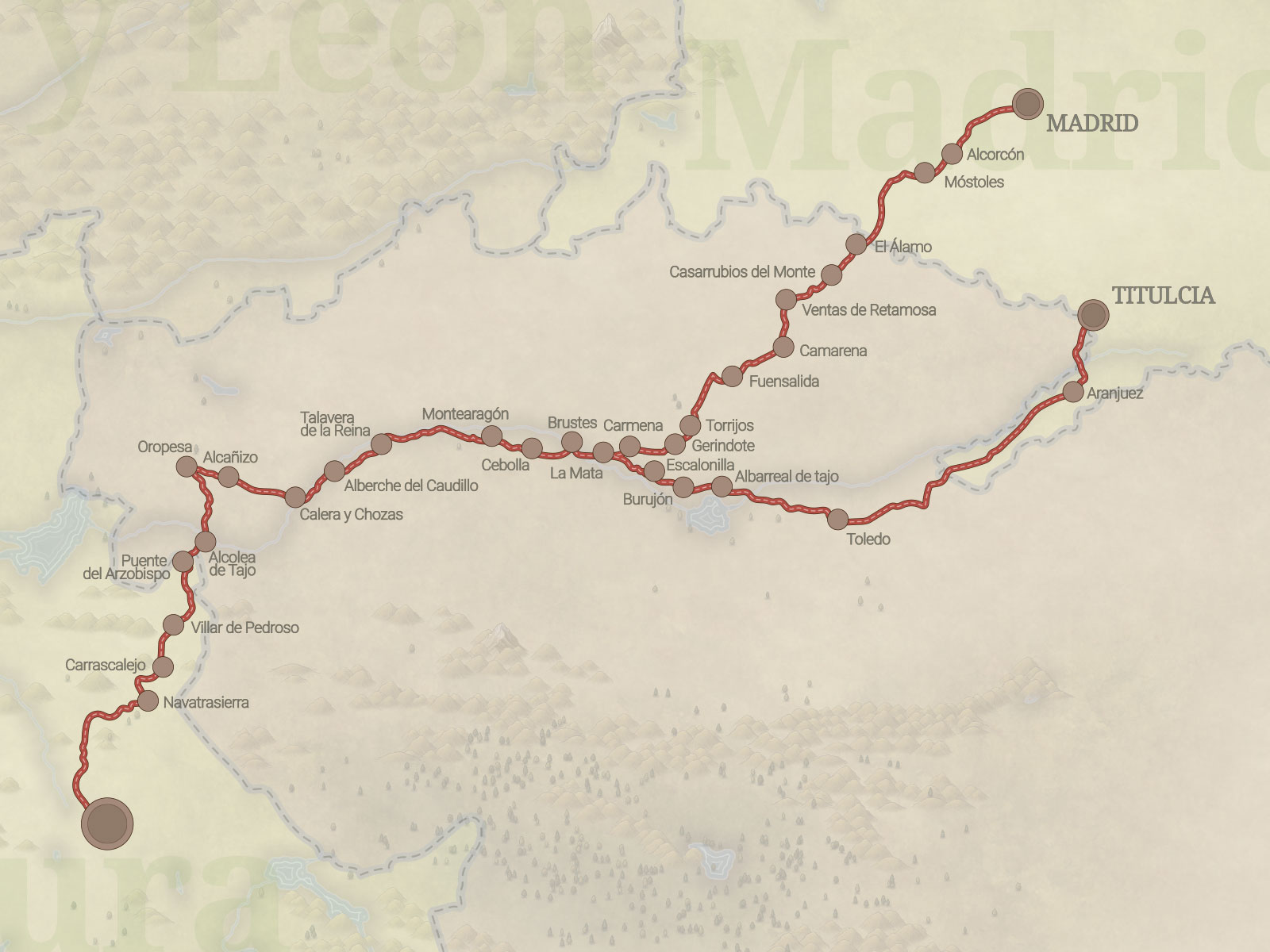
This route, already used as a line of communication by the Romans and later by the Arabs, played a decisive role after the monastery of Guadalupe was built in the 14th century. Mainly through the pilgrimages that linked it with Castile, it was one of the busiest routes from the Late Middle Ages onwards, reaching its peak between the 15th and 16th centuries. Widely described and cited by numerous sources, it was a channel for Marian devotion and for the adventure of thousands of pilgrims who travelled throughout the year from many different parts of Spain. Many illustrious travellers recorded, at different times, the places they passed through and visited on their long journeys along the Camino Real: the landscapes, paths, inns and towns that made up the historic course of our route, which have been very useful, transferred and adapted as far as possible, in reconstructing the Way.
The importance of Guadalupe as a pilgrimage centre from the 14th to the 16th centuries is beyond dispute, especially after the conquest of Seville, which moved the Castilian court southwards, leaving Santiago too far away for frequent pilgrimages in search of graces and indulgences.
Alfonso XI and his son Peter I supported the creation of the Secular Priory of Guadalupe and the construction of a Shrine for pilgrimages, thus consolidating this route with a hospital, colleges, a guesthouse and other services. But it was the Catholic Monarchs who consolidated the Camino Real: the queen is said to have travelled to Guadalupe sixteen times, on at least seven of which she used this Way.
Its designation as Camino Real (Royal Road) became established in Habsburg Spain, as it was protected and used by its various monarchs. At the time, “royal roads” were communication routes that belonged to the king and therefore could not be sold, ploughed up or encroached upon. They were also known as ‘bridle roads’, as they were paved with stone. It was also a route for the post relays carrying the royal mail.
Religious figures came on pilgrimage, such as Saint Peter of Alcántara, Saint Teresa of Jesus and Saint Francis Borgia… as well as others, such as Christopher Columbus, who brought the natives Cristóbal and Pedro here to be baptised, and later Miguel de Cervantes, who came to offer his chains to the Virgin after being freed from the dungeons of Oran.
And so, until the end of the 17th century, Guadalupe kept its character as a place of pilgrimage and spiritual centre of the kingdom, enjoying the favour of the House of Habsburg.