

We named this way after the ‘Descubridores’ (the Explorers), the figures who took part in the exploration, conquest and later colonisation of the lands of the New World. Many pilgrims from Extremadura and from Portugal, a historic nation as closely linked to Guadalupe as Spain itself, arrived along it.
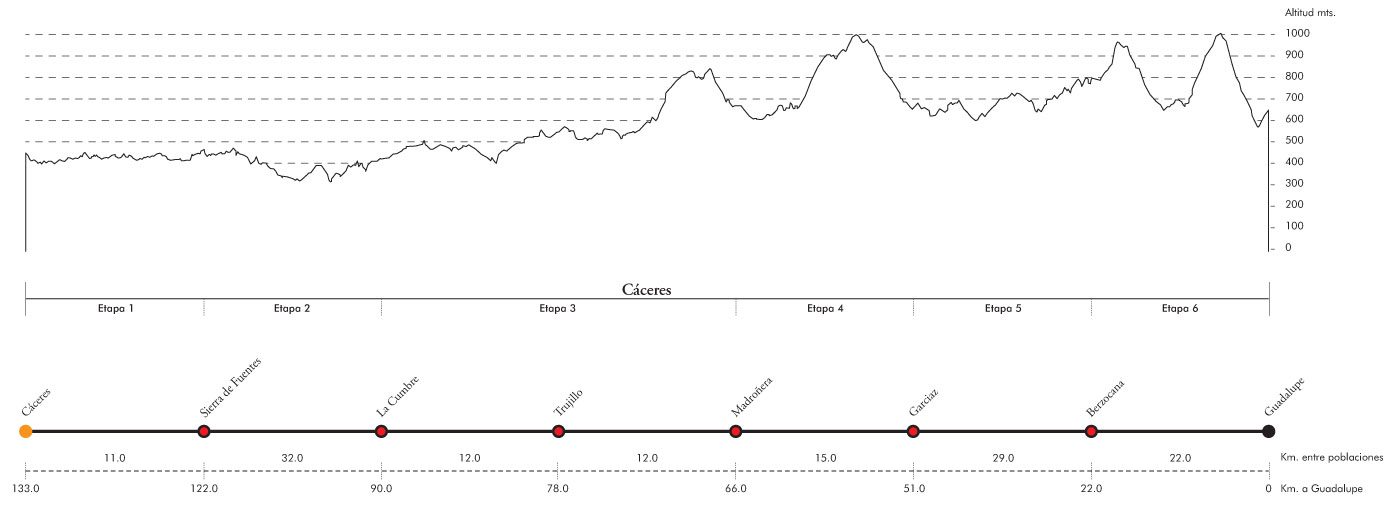
For this reason, and because it was used by our protagonists coming from Seville along the Vía de la Plata, through cities such as Mérida, Cáceres and Trujillo, this way, full of legends, tales and stories, came to be so named. Many of our explorers are associated with these cities, as they were born or lived in one of them: Francisco Pizarro and Francisco de Orellana, natives of Trujillo; Hernán Cortés, from Medellín, near Mérida; and Juan Cano de Saavedra, Francisco de Godoy and Mencía de los Nidos, in Cáceres.
The Monastery of Guadalupe was linked to the American expeditions and became a place of pilgrimage and a meeting point for these men as they planned their overseas adventure. On their return, most of them paid heartfelt tribute to the Virgin of Guadalupe.
Illustrious figures associated and dedicated many conquered places to Guadalupe, such as the name given to one of the three caravels that discovered the New World, the Santa María, or the naming of the island of Guadeloupe by Christopher Columbus in the Lesser Antilles.
By the end of the 16th century, devotion to Mary of Guadalupe had spread throughout South America, and the shrines built there received large donations. Knowing that the conquistadors came from Extremadura, the Hieronymites took for granted their great devotion to Mary of Guadalupe of Extremadura, believing that devotion to Guadalupe in America was simply an extension of the Spanish one.
An emblematic figure closely linked to Guadalupe is Admiral Christopher Columbus, the great discoverer of the New World, who visited the shrine several times to meet the Catholic Monarchs and seek funding for his enterprise. When Columbus came to Guadalupe in 1496, two of his servants were baptised in the fountain basin in the square in front of the shrine. Columbus offered Our Lady a silver lamp and several gold jewels (as recorded in the Book of Benefactors of Guadalupe, manuscript ninety of the Royal Archive of the Monastery).